GARAGE INSULATION: KEY FACTORS TO CONSIDER FOR EFFECTIVE INSULATION
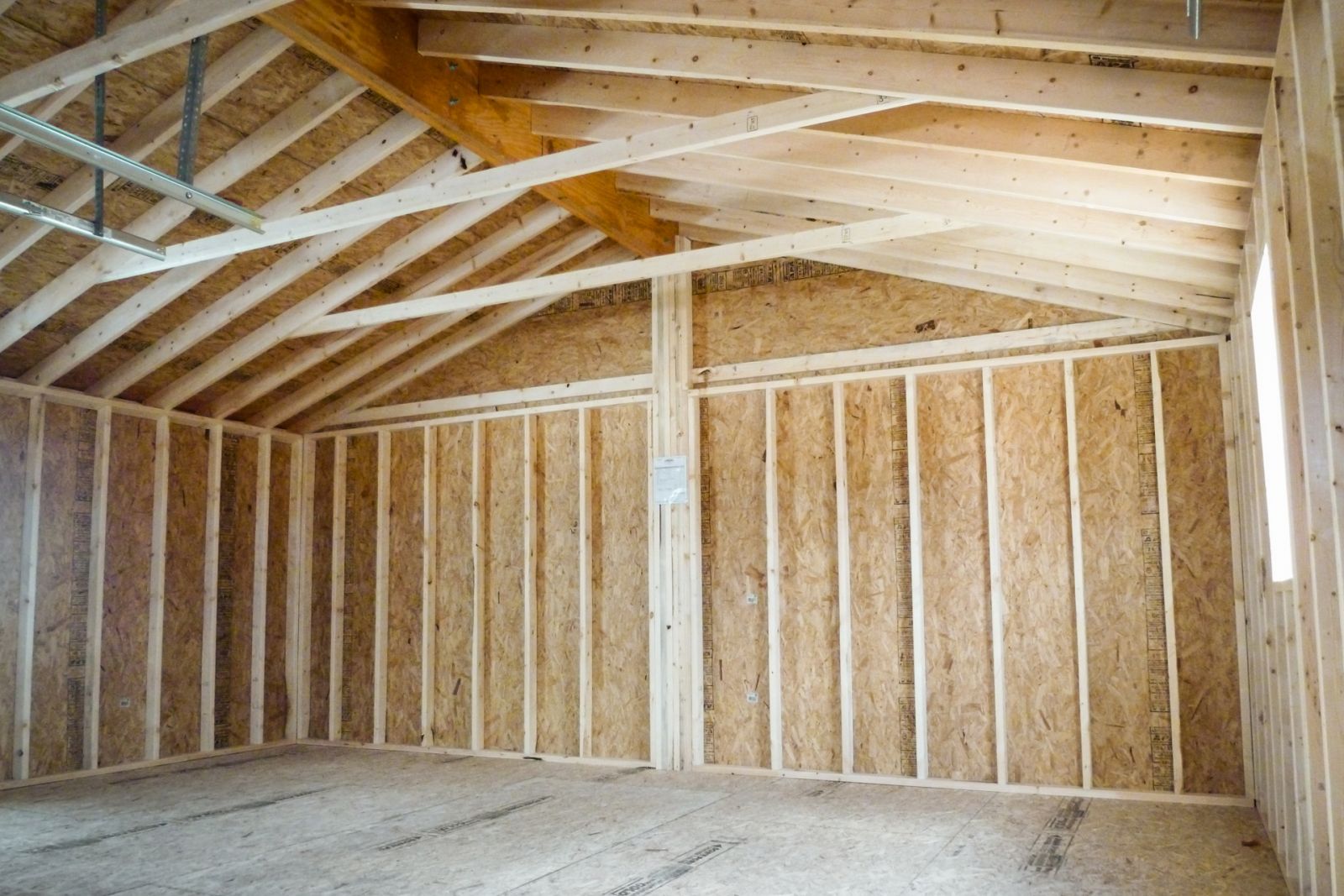
Garage Insulation in Toronto: Key Factors to Consider for Effective Results (2026 Guide)
Your garage might be the most underutilized space in your home — a cold, damp storage area for 9 months of the year when it could be a workshop, gym, hobby space, or simply a more comfortable place to start your car on a January morning in Scarborough, North York, or Vaughan. Proper garage insulation is the single upgrade that transforms a garage from a cold box into a genuinely usable extension of your living space.
But garage insulation isn’t one-size-fits-all. The right approach depends on your garage type, how you plan to use the space, and what your attached home’s energy performance goals are. This guide walks through the key factors that determine the best insulation strategy for Toronto garages in 2026 — including specific considerations for attached vs. detached garages, Ontario Building Code fire separation requirements, and CAD pricing for spray foam installation.
Factor 1: Attached vs. Detached Garage
The most important distinction in garage insulation planning is whether your garage is attached to your home or free-standing.
Attached Garages: An attached garage shares at least one wall and often a ceiling with your living space. This makes it both an insulation priority and a fire safety concern. The Ontario Building Code requires a fire separation between an attached garage and the dwelling — typically a minimum 30-minute fire-rated assembly. This means the shared wall and ceiling must include appropriate drywall (Type X), proper blocking, and no unprotected penetrations.
For energy performance, the shared wall and the garage ceiling (which is often the subfloor of a room above) are critical insulation zones. Spray foam on these surfaces provides both superior thermal performance and — when used in conjunction with appropriate drywall — contributes to the fire separation requirement.
Detached Garages: A detached garage has no fire separation requirement relative to the house, but it typically has even worse thermal performance since all four walls and the roof are exposed to exterior conditions. If you want to use your detached garage year-round in Toronto’s climate, a comprehensive spray foam approach — walls, roof underside, and slab edge — is the most effective solution.
Factor 2: What You Want to Do with the Space
The intended use of the garage has a major impact on the required insulation specification:
Basic car storage (minimize freezing pipes, protect vehicles): Rim joist and ceiling spray foam, with minimal wall insulation, will keep the space above freezing in all but the coldest Toronto nights. Estimated cost: $1,500–$3,000 CAD.
Workshop, home gym, or hobby space (usable year-round): Full wall, ceiling, and floor perimeter spray foam, plus an independent heating source (electric heater or mini-split heat pump). Target: R-20 walls, R-30+ ceiling. Estimated cost: $4,000–$9,000 CAD depending on garage size.
Conditioned living space conversion (home office, studio): Requires building permit, full OBC compliance including fire separation, and potentially electrical upgrades. Spray foam throughout is the baseline — additional finishes, HVAC, and electrical bring total project cost to $15,000–$35,000+ CAD depending on scope.
Factor 3: Garage Ceiling and Roof Assembly
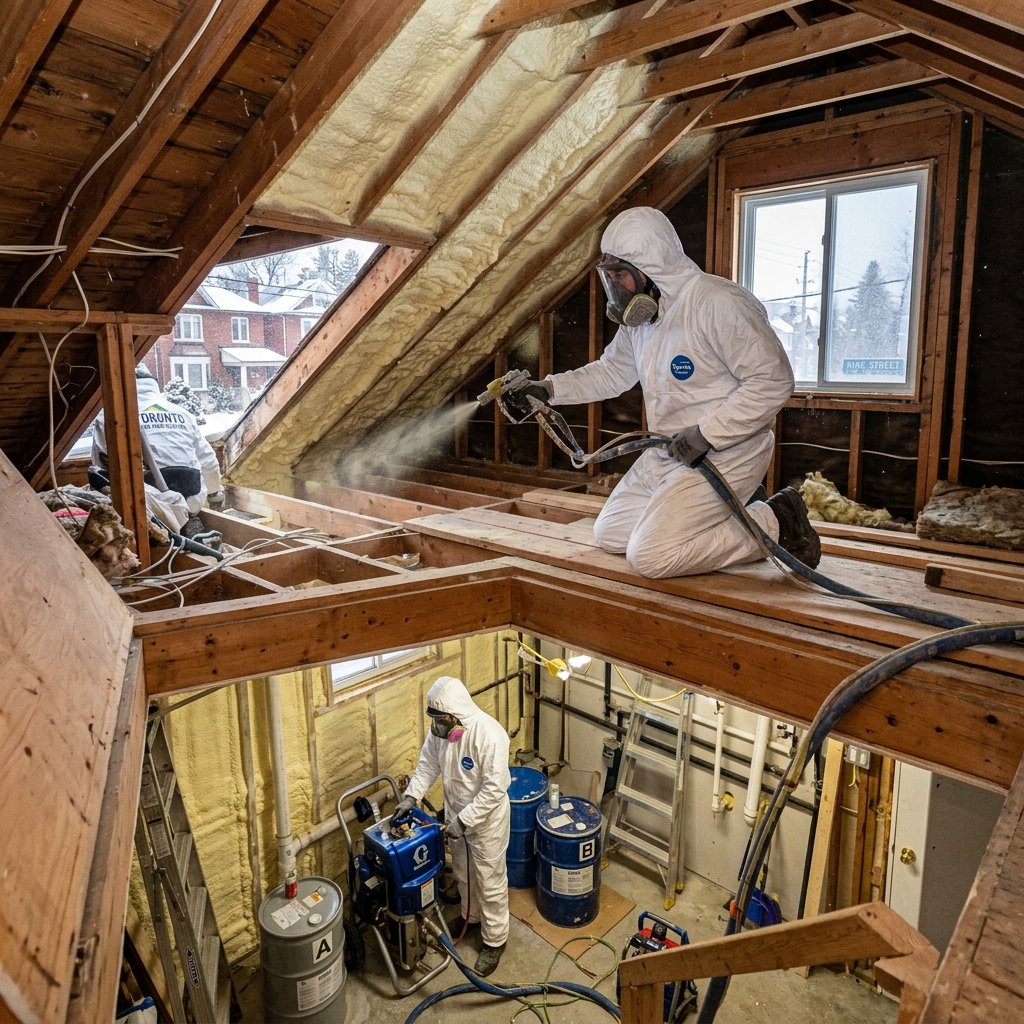
If your garage has a flat or sloped ceiling with an unconditioned attic space above, the ceiling is the primary heat loss zone. Spray foam on the ceiling drywall (from above, in the attic space) or on the underside of the roof deck (converting to an unvented attic) is the most effective upgrade.
For garages with an open rafter/no ceiling configuration — common in older Etobicoke and Scarborough detached garages — spray foam applied directly to the underside of the roof deck converts the entire roof assembly to a warm, insulated structure. This eliminates the need for a separate ceiling and provides immediate comfort improvement.
Factor 4: Ontario Building Code Fire Requirements
For attached garages in the GTA, OBC compliance is not optional. Key requirements in 2026 include:
The wall between an attached garage and the dwelling must achieve a minimum 30-minute fire-resistance rating. This is typically achieved with 5/8″ Type X gypsum drywall on the garage side of the shared wall. Spray foam on this wall cavity improves thermal performance but does not replace the drywall requirement — both are needed.
The ceiling of an attached garage (if there is a room above) also requires fire-rated assembly. Any penetrations — pot lights, electrical, HVAC ducts — must be fire-stopped with appropriate products. Spray foam Spray Foam Kings can advise on fire stopping requirements for any specific configuration.
Spray Foam Kings is fully familiar with OBC requirements for attached garage assemblies in Toronto, Mississauga, Brampton, and all GTA municipalities, and will ensure your project meets all applicable requirements.
Factor 5: Garage Door Insulation
The garage door is typically the largest source of heat loss in any garage — often accounting for 40–50% of total thermal loss in an uninsulated garage. Options include:
Replacing your existing door with an insulated door (R-8 to R-18 rated) — a significant improvement but costly ($1,500–$4,000 CAD for supply and install). Applying rigid foam insulation panels to the inside of an existing door (DIY-friendly, R-4 to R-8, $200–$500 CAD). Note: adding weight to an existing door may require spring adjustment.
Spray Foam Kings focuses on the structural envelope — walls, ceiling, rim joists — rather than door replacement, but we can advise on the best integrated approach for your specific garage configuration.
2026 CAD Pricing: Garage Spray Foam Insulation in Toronto
| Scope | Garage Size | CAD Cost Range |
|---|---|---|
| Ceiling only (closed-cell, 3″) | 400–600 sq ft | $1,500 – $3,000 |
| Ceiling + walls (closed-cell) | Single car | $3,000 – $5,500 |
| Full envelope (ceiling + walls + rim) | Double car | $5,000 – $10,000 |
| Open rafter roofline spray (closed-cell) | Single car | $2,500 – $4,500 |
| Workshop-ready full package | Double car | $7,000 – $14,000 |
Frequently Asked Questions About Garage Insulation
Do I need a building permit to insulate my attached garage in Toronto?
Adding insulation to an existing garage typically doesn’t require a permit unless you’re changing the use of the space (e.g., converting to living space) or adding new electrical or HVAC. However, any work that affects the fire separation between the garage and dwelling may trigger inspection requirements. Spray Foam Kings will advise on permit requirements during your assessment.
What’s the best insulation product for a garage ceiling in Toronto’s climate?
Closed-cell spray foam is the preferred product for garage ceilings due to its high R-value per inch, vapour barrier properties, and resistance to moisture — important in garages where vehicles bring in snow and moisture. Two to three inches of closed-cell foam provides R-12 to R-20 of continuous insulation with no thermal bridging.
Will insulating my garage reduce condensation on the walls and ceiling?
Yes. Condensation in garages is caused by warm, moist air contacting cold surfaces. Insulating the walls and ceiling raises the surface temperature above the dew point, eliminating or dramatically reducing condensation. This is especially important in garages where you store tools, vehicles, or seasonal equipment that can be damaged by moisture.
How long does garage spray foam insulation last?
Closed-cell spray foam in a garage application lasts indefinitely under normal conditions. It does not settle, sag, or absorb moisture. The only maintenance requirement is protecting the foam from physical damage — in visible areas, we recommend covering it with drywall or plywood after application.
Can I spray foam my garage myself?
Small two-component kits from hardware stores are available, but they produce inconsistent results, waste significant product, and rarely achieve the minimum film thickness needed for code-compliant fire separation applications. For any project larger than a few hundred square feet or involving OBC-regulated assemblies, professional installation by a certified contractor is strongly recommended.
Transform Your Garage Starting Today
Your garage doesn’t have to be a cold, damp afterthought. In 2026, with spray foam insulation costs competitive and energy savings significant, there’s never been a better time to transform your garage into a genuinely useful, comfortable space. Whether you’re in Scarborough, Vaughan, Brampton, or Mississauga, Spray Foam Kings can design and install the right insulation system for your garage — completed in a single day with minimal disruption.
Call 647-641-6881 today for your free garage insulation assessment. We’ll evaluate your specific garage, explain your options, and provide a detailed written quote. No obligation, no pressure — just expert advice from the GTA’s most trusted spray foam team.
Related posts
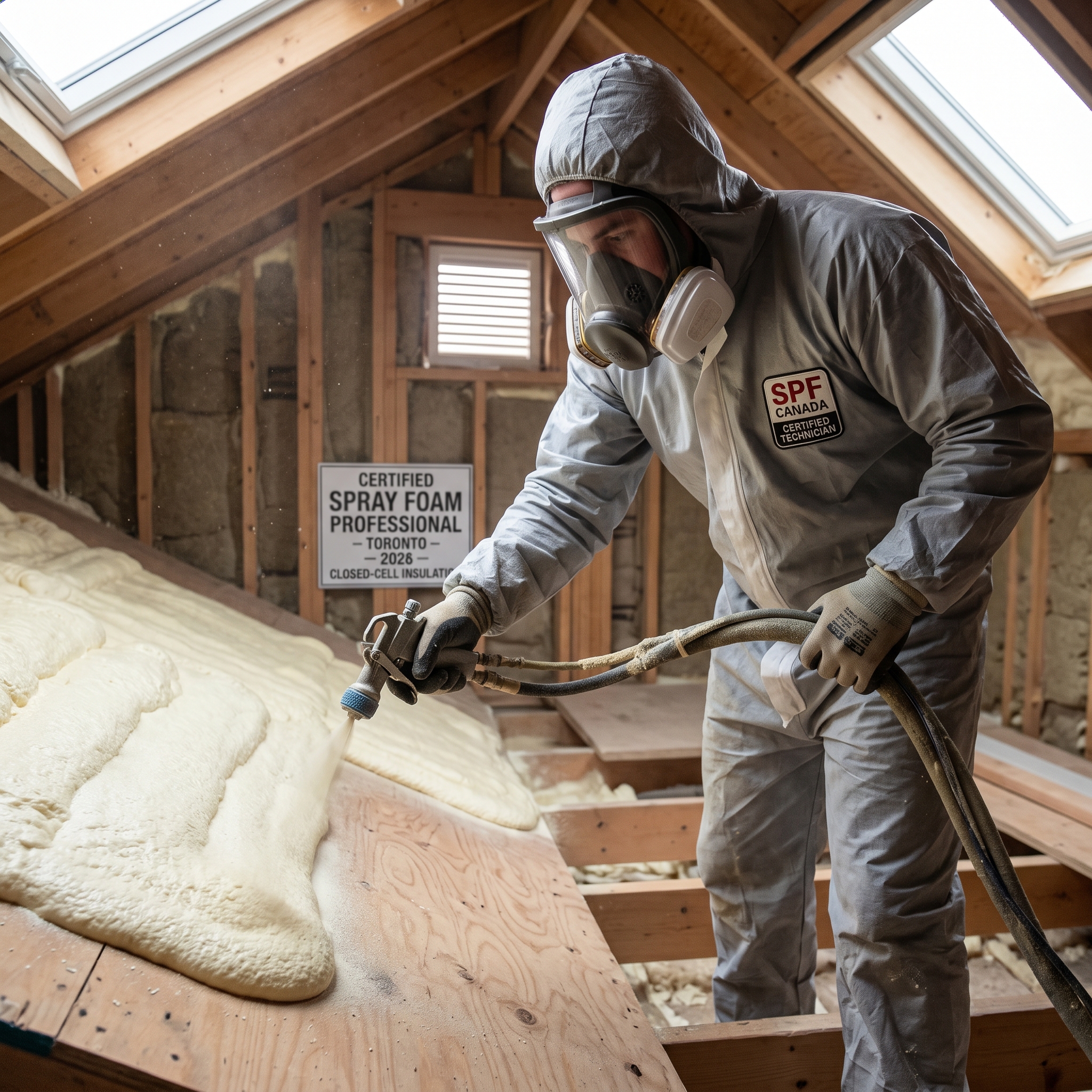
Closed Cell Spray Foam Canada Toronto 2026: Complete Guide
Closed cell spray foam insulation in Canada costs between $2.50 and $5.00 per square foot CAD installed, making it one of the most cost-effective and
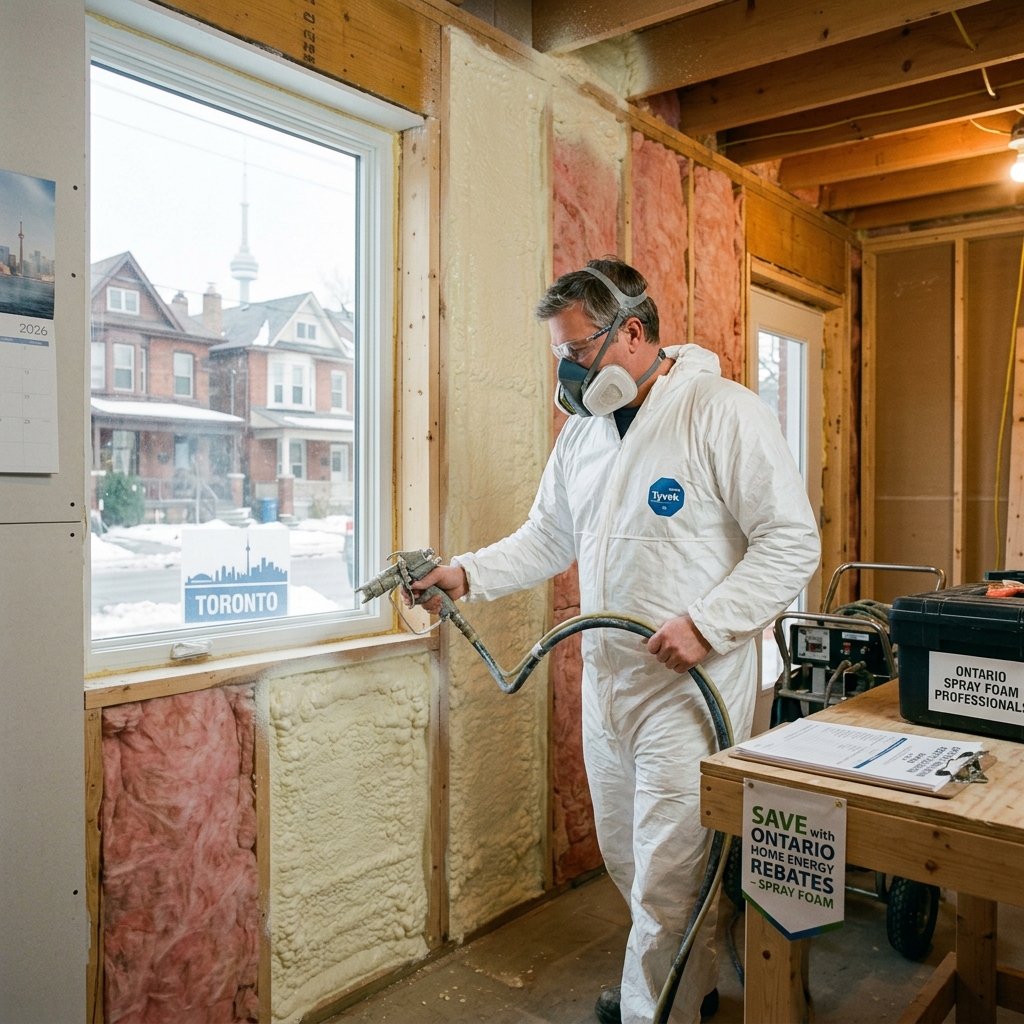
Insulation Rebate Ontario Toronto 2026: Complete Guide
Ontario homeowners who install spray foam insulation can qualify for rebates ranging from $1,600 to $10,600 CAD through federal and provincial programs — and
Spray Foam Insulation Cost Toronto 2026: Exact Pricing for Your Home
Spray foam insulation in Toronto costs $1.50–$3.50 per square foot CAD for open-cell foam and $2.50–$5.00 per square foot CAD for closed-cell foam, fully
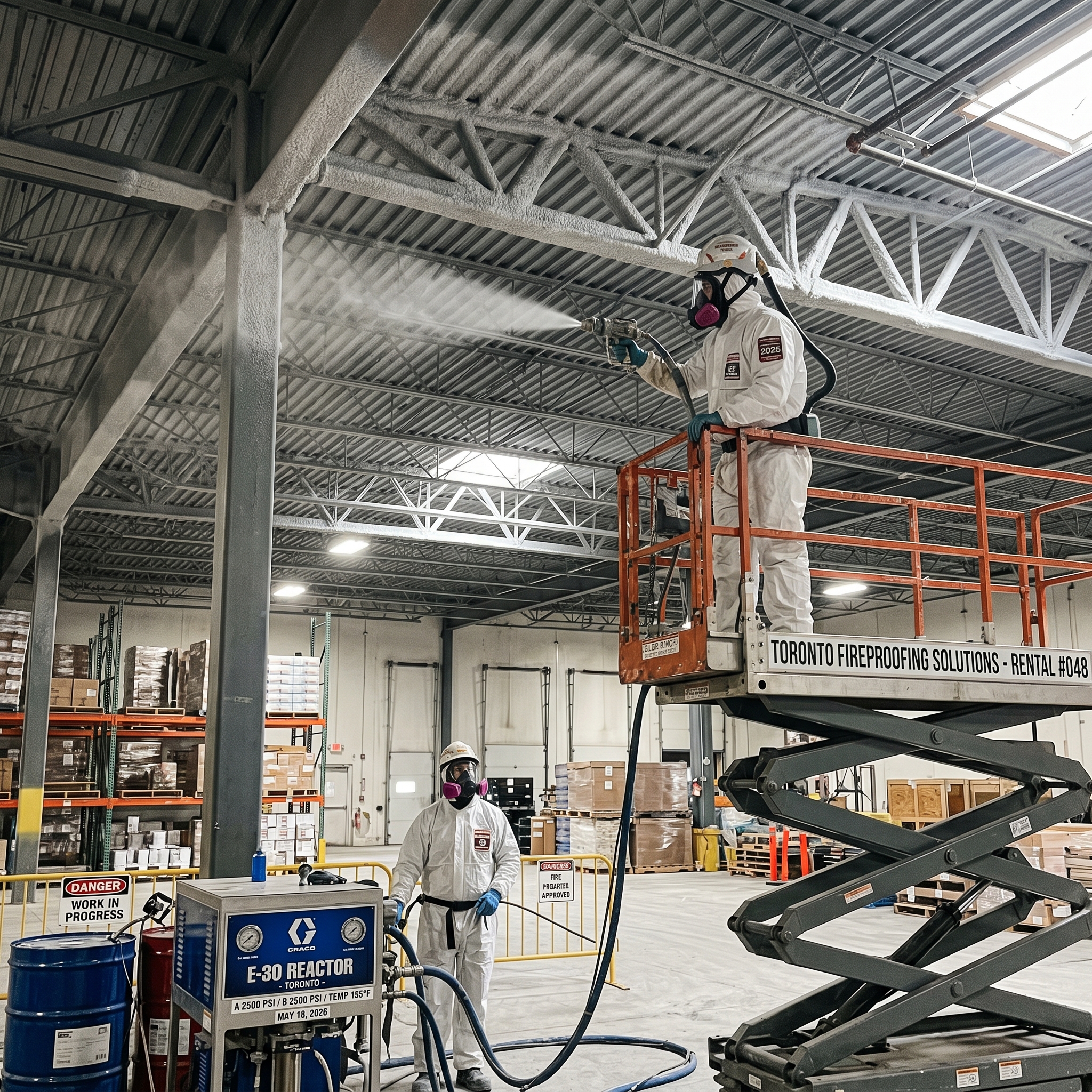
Commercial Spray Foam Fireproofing Services — Toronto & GTA 2026
Commercial spray foam fireproofing in Toronto costs $3.50–$8.00 per square foot installed in 2026, depending on required fire-resistance rating,
Spray Foam Insulation Rebate Ontario 2026: How to Get Up to $10,000 Back on Your Upgrade
Spray foam insulation rebates in Ontario for 2026 can put up to $10,000 CAD back in your pocket when you upgrade from fiberglass or cellulose to