Spray Foam Insulation Cost Toronto 2026: Exact Pricing for Your Home
Spray foam insulation in Toronto costs $1.50–$3.50 per square foot CAD for open-cell foam and $2.50–$5.00 per square foot CAD for closed-cell foam, fully installed in 2026. For a standard 1,200 sq ft attic, most GTA homeowners pay between $2,400 and $7,200 CAD depending on foam type, thickness, and site conditions. Ontario’s Greener Homes Grant can offset up to $10,600 CAD of that cost — making 2026 one of the most affordable years on record to insulate your home with spray foam.
The Short Answer: Spray Foam Insulation Cost in Toronto 2026
Here are the numbers GTA homeowners actually need before calling a contractor:
- Open-cell spray foam (installed): $1.50–$3.50/sqft CAD
- Closed-cell spray foam (installed): $2.50–$5.00/sqft CAD
- Typical attic (1,200 sqft): $2,400–$7,200 CAD all-in
- Typical basement (800 sqft walls): $3,200–$6,400 CAD closed-cell
- Maximum Ontario Greener Homes Grant: Up to $10,600 CAD
- Average energy savings after installation: 20–40% on annual heating/cooling bills
These prices are all-in — labour, materials, site prep, and cleanup. Spray Foam Kings does not charge separately for travel within the GTA. Every quote is free and on-site, never a ballpark estimate over the phone.
Spray Foam Insulation Cost Per Square Foot — Ontario 2026
The cost per square foot varies based on three primary factors: foam chemistry (open vs. closed cell), required thickness to meet Ontario Building Code SB-12 minimums, and site-specific conditions such as attic access, substrate type, and existing insulation removal needs.
Below is a breakdown of material-only costs (for DIY reference) versus professionally installed all-in pricing:
| Foam Type | DIY Material Only (CAD/sqft) | Professionally Installed (CAD/sqft) | R-Value Per Inch |
|---|---|---|---|
| Open-Cell Spray Foam | $0.50–$1.20 | $1.50–$3.50 | ~R-3.7 |
| Closed-Cell Spray Foam | $1.30–$2.00 | $2.50–$5.00 | ~R-6.5 |
| 2-lb Closed-Cell (High-Density) | $1.80–$2.50 | $3.50–$5.50 | ~R-6.5–7.0 |
All prices in CAD. Material-only costs reflect standard hardware store kit pricing. Professionally installed prices include labour, disposal, and surface prep. Prices current as of April 2026.
For most homeowners, the jump from DIY to professional installation is well justified. A misapplied foam job can trap moisture, void roofing warranties, and fail Ontario Building Code inspections — remediation costs often exceed the original project budget.
Open-Cell vs. Closed-Cell Spray Foam: Full Cost Comparison
Choosing the right foam type is as important as finding the right price. Here is a side-by-side comparison of what you actually get for your money:
| Feature | Open-Cell Spray Foam | Closed-Cell Spray Foam |
|---|---|---|
| Installed Cost (CAD/sqft) | $1.50–$3.50 | $2.50–$5.00 |
| R-Value Per Inch | ~R-3.7 | ~R-6.5 |
| Vapour Barrier | No (permeable) | Yes (at ≥2 inches) |
| Air Barrier | Yes | Yes |
| Structural Rigidity | Low (soft, flexible) | High (rigid, adds strength) |
| Best For | Attics, interior walls, sound control | Basements, crawl spaces, rim joists, rooflines |
| Water Resistance | Absorbs moisture | Highly water-resistant |
| Ontario Building Code (SB-12) | Compliant above-grade | Required below-grade/vapour-sensitive zones |
| Expansion Rate | 100:1 (fills cavities completely) | 30:1 (dense, controlled) |
| Typical Payback Period | 5–8 years | 7–10 years (longer but higher R-value) |
Need help choosing? Learn more about open-cell spray foam or explore our closed-cell spray foam services. Still unsure? Our estimators will assess your building envelope on-site and recommend the most cost-effective solution for your specific project.
Spray Foam Cost by Toronto Neighbourhood
Location within the GTA affects pricing in two ways: job site logistics (parking, building access, scaffold requirements) and local competitive pricing pressure. Here is what GTA homeowners typically pay for a standard attic insulation job (1,200 sqft open-cell to R-31):
| Neighbourhood / Area | Typical Attic Job (CAD) | Notes |
|---|---|---|
| Downtown Toronto (C01–C08) | $3,200–$5,400 | Narrow laneways, limited parking, older homes with complex framing |
| North York | $2,800–$4,800 | Mix of bungalows and two-storey; most straightforward access |
| Scarborough | $2,600–$4,500 | Larger lots, easier equipment access, competitive market |
| Etobicoke | $2,700–$4,600 | Suburban homes, good access, occasional asbestos remediation in older builds |
| Mississauga | $2,500–$4,400 | Large subdivisions, efficient logistics for multiple jobs |
| Vaughan | $2,600–$4,500 | Newer builds often pre-drilled for spray foam; faster installs |
| Markham | $2,600–$4,600 | High density of newer townhomes; party wall considerations |
| Brampton | $2,400–$4,200 | Newer housing stock, most affordable pricing in GTA |
Prices above are for professional open-cell spray foam installation to code-minimum thickness. Closed-cell or thicker applications will be 40–60% higher. All prices CAD, 2026 rates.
Spray Foam Cost by Room Type — Attic, Basement, Walls & Garage
The room type dictates both the foam type and required thickness, which together determine your total project cost. Here is what Toronto homeowners actually spend room by room:
Attic Insulation
Attic spray foam insulation is the most common project we handle in the GTA. Open-cell foam sprayed to 5.5 inches delivers approximately R-20, while 8.5 inches reaches R-31 — the SB-12 minimum for most of Ontario’s climate zone. Cost range: $1,800–$5,400 CAD for a 1,000–1,500 sqft attic floor depending on foam type and thickness. Spray-sealing the attic hatch, pot light penetrations, and eave baffles is included in professional quotes from Spray Foam Kings.
Basement Insulation
Basement spray foam insulation almost always requires closed-cell foam to manage moisture vapour from the below-grade environment. Applying 2 inches of closed-cell to rim joists and 3 inches to concrete foundation walls delivers R-13–R-19. Cost range: $2,400–$6,400 CAD for a typical 800–1,200 sqft basement perimeter. Many Toronto homeowners prioritize the rim joist first — a 200 lineal foot rim joist package typically runs $1,200–$2,000 CAD and delivers outsized energy savings per dollar spent.
Exterior Walls
Wall spray foam is applied during new construction or major renovations when wall cavities are exposed. Open-cell foam in a 3.5-inch stud cavity delivers R-13; closed-cell in the same cavity delivers R-22. Cost range: $1.80–$4.50/sqft CAD of wall area, depending on foam type and cavity depth. For a standard Toronto semi-detached (approximately 1,400 sqft of exterior wall area), expect to budget $2,500–$6,300 CAD.
Garage Insulation
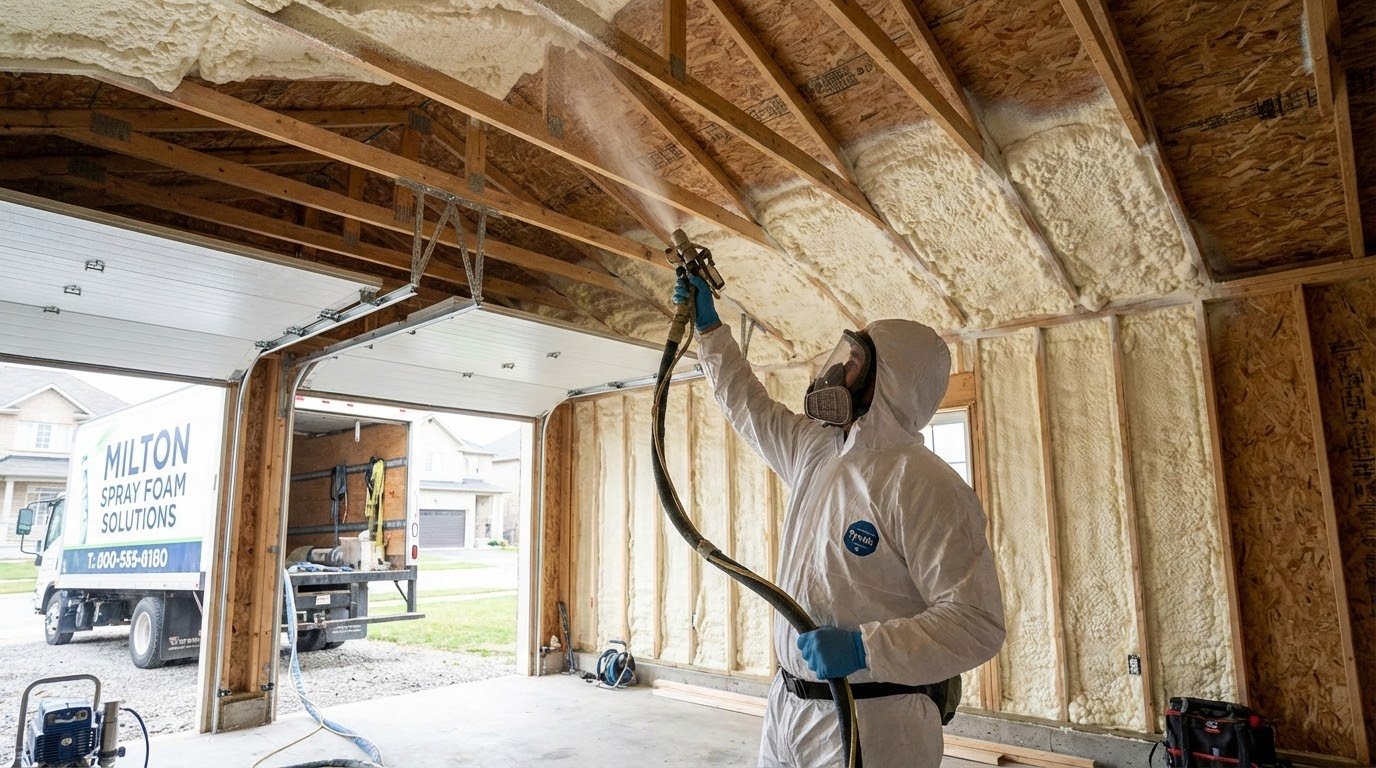
Attached garages benefit from spray foam on shared walls and ceilings to prevent thermal bridging into living spaces and to reduce fire risk from vapour penetration. Open-cell is generally used for garage ceilings; closed-cell is recommended for garage walls shared with conditioned space. Cost range: $1,200–$3,200 CAD for a standard double-car garage depending on scope.
Crawl Space
Crawl spaces require closed-cell foam for moisture management. Encapsulating a 600–800 sqft crawl space with 2 inches of closed-cell typically costs $2,000–$4,800 CAD and eliminates the primary source of ground-moisture intrusion in many older Toronto-area homes.
DIY vs. Professional Spray Foam Installation — True Cost Comparison
Hardware store spray foam kits tempt many homeowners with lower material costs. Here is an honest breakdown of what DIY actually costs versus professional installation:
- DIY open-cell kit (600 sqft, 1 inch): $320–$480 CAD in materials + $80–$150 in PPE (respirator, suit, gloves) = $400–$630 CAD
- Professional open-cell (600 sqft, 1 inch): $900–$2,100 CAD installed, warranted, code-compliant
- DIY risk exposure: Misapplication, insufficient thickness, moisture trapping, failed inspections, potential remediation costs of $2,000–$8,000 CAD
DIY foam kits are appropriate for small gap-sealing tasks — around pipes, window frames, and electrical penetrations. For area applications of more than 100 sqft, professional installation almost always delivers better cost-per-outcome when remediation risk is factored in. SPFA-certified contractors use commercial proportioner rigs that maintain precise temperature and pressure ratios — hardware store kits cannot replicate this, resulting in inconsistent cell structure and lower actual R-values than labeled.
Use our spray foam cost calculator to estimate your project before calling us.
Hidden Costs and Factors That Affect Your Final Price
Your final invoice may differ from the per-square-foot estimate if any of the following apply to your property:
- Existing insulation removal: Removing old batt or blown-in insulation before spray foam application adds $0.30–$0.80/sqft CAD in most cases. We handle removal and disposal.
- Air sealing pre-work: Penetrations, cracks, and gaps that must be sealed before foam application are included in our quote — some contractors charge separately.
- Asbestos testing/abatement: Homes built before 1985 in Toronto may require asbestos testing of existing insulation. Testing runs $200–$500 CAD; abatement varies widely.
- Attic hatch and pot lights: Spray-sealing 10–15 pot lights and the attic hatch adds roughly $150–$400 CAD to a standard attic job.
- Access difficulty: Low-pitch roofs, knee walls, or attics requiring interior scaffolding may add 10–20% to labour costs.
- Thickness upgrades: Going from code-minimum R-20 to enhanced R-31 or R-40 increases material volume significantly — typically 40–80% more material cost.
- Fire barrier coating: In finished living spaces, spray foam must be covered with a thermal/ignition barrier (typically 12 mm drywall). This is a code requirement, not an upsell.
Spray Foam Kings quotes all foreseeable costs upfront during our free on-site assessment. We do not add line items after work begins.
Ontario Insulation Rebates 2026 — Greener Homes Grant and IESO Programs
2026 offers the strongest rebate environment for insulation upgrades in Ontario history. Here is what is currently available:
- Canada Greener Homes Grant: Up to $10,600 CAD for eligible home energy upgrades including insulation. Spray foam applied to attics and basements qualifies. Requires a pre- and post-retrofit EnerGuide evaluation ($600–$1,200 CAD, partially reimbursed). Applications remain open in 2026.
- IESO Home Efficiency Rebate Plus (HER+): Up to $10,000 CAD in rebates for insulation, air sealing, and mechanical upgrades through participating contractors. Spray foam is an eligible measure. Unlike the federal grant, HER+ does not require an EnerGuide audit in all cases — making it faster to access for many homeowners.
- Union Gas / Enbridge Gas Rebates: Enbridge Gas offers rebates of $0.10–$0.15/RSI of insulation improvement in some Toronto-area postal codes. A typical attic upgrade from R-12 to R-40 may yield $150–$400 CAD additionally.
- Toronto Green Standard (new builds): New construction projects that exceed OBC minimum insulation requirements may qualify for expedited permit review under the City of Toronto’s green building program.
Spray Foam Kings works with homeowners to document and submit rebate applications. We provide all required project documentation including pre/post measurements, product spec sheets, and installation records. Ask about our rebate assistance during your free quote.
Ontario Building Code 2026 — What SB-12 Requires for Spray Foam
Supplementary Standard SB-12 of the Ontario Building Code sets minimum effective thermal resistance (RSI/R-value) for all building envelope assemblies. In Climate Zone 6 (which covers most of the GTA), current minimums include:
- Attic/ceiling: RSI-8.67 (approximately R-49) for new construction; R-31 minimum for retrofits in most municipalities
- Above-grade walls: RSI-3.08 (approximately R-17.5) effective for the whole wall assembly
- Below-grade walls (basement): RSI-1.96 (approximately R-11) minimum for conditioned basements
- Floors over unheated space: RSI-5.02 (approximately R-28.5)
Spray foam is unique in that it functions as both an insulation layer and an air barrier — meeting two code requirements simultaneously. This is particularly valuable in SB-12 compliance because the code requires a continuous air barrier throughout the building envelope.
Vapour barrier requirements: Closed-cell spray foam at 2 inches or more is recognized as a Class II vapour retarder under the Ontario Building Code, eliminating the need for a separate 6-mil poly vapour barrier in most below-grade applications. Open-cell foam is vapour-permeable and requires a separate vapour barrier in below-grade and high-moisture environments.
All Spray Foam Kings installations are inspected for code compliance. We carry drawings and product specification sheets on every job site for inspector reference.
Spray Foam Insulation Service Areas — GTA Pricing by Region
Spray Foam Kings serves the full Greater Toronto Area with consistent pricing and the same SPFA-certified crews throughout. Here is regional pricing context for our most common project type (attic open-cell to R-31, approx. 1,200 sqft):
- Toronto (all districts): $2,800–$5,400 CAD — downtown premiums apply for access restrictions
- Scarborough: $2,600–$4,500 CAD — large suburban lots, easy equipment positioning
- North York: $2,800–$4,800 CAD — high volume of bungalows with straightforward attic access
- Etobicoke: $2,700–$4,600 CAD — mix of postwar and newer housing stock
- Vaughan: $2,600–$4,500 CAD — strong new construction market, efficient installs
- Mississauga: $2,500–$4,400 CAD — most competitive market in the GTA
- Markham: $2,600–$4,600 CAD — townhome-heavy; wall party considerations on quotes
- Brampton: $2,400–$4,200 CAD — newer housing stock, lowest average project cost
We do not charge trip fees within these areas. Emergency same-week scheduling is available in most neighbourhoods subject to crew availability.
“We got three quotes for our Leslieville attic — Spray Foam Kings came in at $3,400 CAD all-in for open-cell to R-31 and were the only ones who walked the attic themselves before quoting. The job was done in a day, the crew was incredibly clean, and our gas bill dropped over $180 in the first month. We got $4,200 back through the Greener Homes Grant as well. Absolutely worth it in 2026.”
— Jennifer M., Leslieville, Toronto, February 2026
Why Choose Spray Foam Kings for Your Toronto Insulation Project
There are dozens of spray foam contractors in the GTA. Here is why homeowners and property managers consistently choose Spray Foam Kings:
- SPFA Member & Certified: Spray Polyurethane Foam Alliance certification means our applicators are trained to industry standards, not just licensed to operate equipment.
- $5 Million Liability Insurance: Full commercial general liability coverage protects your property on every job, no exceptions.
- WSIB Compliant: All crew members are covered under WSIB. We will provide a clearance certificate on request.
- 15+ Years in the GTA: Spray Foam Kings has been operating in Toronto and surrounding areas since 2010. We have insulated thousands of homes across every neighbourhood on this page.
- Free On-Site Quotes: No phone estimates. We come to your property, assess the building envelope, identify hidden problem areas, and provide a written fixed-price quote before any commitment.
- Rebate Documentation Support: We provide all paperwork required for Greener Homes Grant and HER+ applications.
- Clean Job Sites: Our crews mask, protect, and clean thoroughly on every project. We do not leave foam overspray or packaging debris behind.
- 4.9-Star Rating (287 Reviews): Consistently rated among the top spray foam contractors in Toronto on Google.
Get Your Free Quote Today
✓ SPFA Certified
✓ $5M Liability Insurance
✓ Free on-site quotes across the GTA
✓ Rebate documentation support included
Call: 647-641-6881
Or use our spray foam cost calculator to get an instant ballpark before we visit.
Frequently Asked Questions — Spray Foam Insulation Cost Toronto 2026
How much does spray foam insulation cost per square foot in Toronto?
In 2026, professionally installed spray foam in Toronto costs $1.50–$3.50 per square foot CAD for open-cell foam and $2.50–$5.00 per square foot CAD for closed-cell foam. These are all-in prices including labour, materials, and cleanup. DIY material kits cost $0.50–$1.20/sqft (open-cell) or $1.30–$2.00/sqft (closed-cell) before equipment and safety gear.
What does it cost to spray foam an attic in Toronto?
A standard 1,000–1,500 sqft attic in Toronto typically costs $2,400–$5,400 CAD for open-cell spray foam to R-31. Closed-cell foam for the same attic runs $4,000–$8,000 CAD but is rarely necessary above grade. Most Toronto attics use open-cell foam for its superior cavity-filling expansion and sound attenuation properties.
How much does basement spray foam cost in Ontario?
Basement spray foam insulation in Ontario costs $2,400–$6,400 CAD for a typical 800–1,200 sqft basement perimeter. Closed-cell foam is required below grade for moisture management. Rim joist spray foam alone — often the highest-ROI improvement — runs $1,200–$2,000 CAD for a typical Toronto home and can noticeably reduce drafts and heating bills within weeks.
Is spray foam insulation worth the cost in Toronto?
Yes, for most Toronto homes built before 2000. The average GTA homeowner saves 20–40% on annual heating and cooling costs after professional spray foam installation. At current natural gas and electricity rates in Ontario, a $4,000 CAD attic project typically pays back in 5–8 years — and with Ontario Greener Homes Grant rebates of up to $10,600 CAD, payback can drop to 2–4 years. Spray foam also improves indoor air quality, reduces noise, and adds structural rigidity.
Can I get a rebate for spray foam insulation in Ontario in 2026?
Yes. The Canada Greener Homes Grant offers up to $10,600 CAD for eligible insulation upgrades including spray foam. The IESO Home Efficiency Rebate Plus program offers up to $10,000 CAD additionally. Enbridge Gas also offers supplementary rebates in some GTA postal codes. Spray Foam Kings provides full documentation support for all provincial and federal rebate programs. Ask about eligibility during your free on-site quote.
What is the difference in cost between open-cell and closed-cell spray foam?
Closed-cell spray foam costs roughly 40–60% more than open-cell foam per square foot installed. Open-cell runs $1.50–$3.50/sqft CAD; closed-cell runs $2.50–$5.00/sqft CAD. However, closed-cell delivers approximately R-6.5 per inch vs. R-3.7 for open-cell — meaning you need less thickness to achieve the same R-value. For below-grade applications where a vapour barrier is required by Ontario Building Code, closed-cell is not optional regardless of cost.
How long does spray foam insulation last in Toronto homes?
Properly installed spray foam insulation is considered a lifetime building material — it does not sag, settle, or degrade like fibreglass batts or blown-in cellulose. Industry data and manufacturer warranties suggest a service life of 80+ years under normal conditions. In Toronto’s climate, where attics experience extreme thermal cycling (-30°C winters to +40°C attic summers), spray foam significantly outperforms competing insulation types in long-term R-value retention.
Does spray foam insulation require a building permit in Toronto?
Spray foam insulation applied to existing homes generally does not require a standalone building permit in the City of Toronto for maintenance or upgrade work. However, if the insulation is part of a larger renovation that triggers permit requirements (e.g., finished basement, addition, or change of use), the insulation work falls under that permit. New construction always requires permit compliance with SB-12. Spray Foam Kings advises on permit requirements during every free on-site quote.
How long does it take to install spray foam insulation in a Toronto home?
A standard attic spray foam job on a typical Toronto home (1,000–1,500 sqft) takes 4–8 hours from equipment setup to cleanup. Basement perimeter and rim joist jobs take 3–6 hours. Re-entry time after spray foam application is typically 24 hours for full cure, though most areas are safe to enter in 1–2 hours once foam is tack-free. Our crews complete most residential projects in a single day.
What spray foam thickness is required under Ontario Building Code SB-12?
Under SB-12 for most of the GTA (Climate Zone 6), attic retrofits typically require a minimum of R-31 effective — approximately 8.5 inches of open-cell foam or 4.75 inches of closed-cell. New construction attics must reach R-49 (approximately 13 inches open-cell or 7.5 inches closed-cell). Basement walls require a minimum of RSI-1.96 (approximately R-11), achievable with 1.5–2 inches of closed-cell foam. Our estimators confirm code requirements for your specific project during on-site assessment.
Related posts
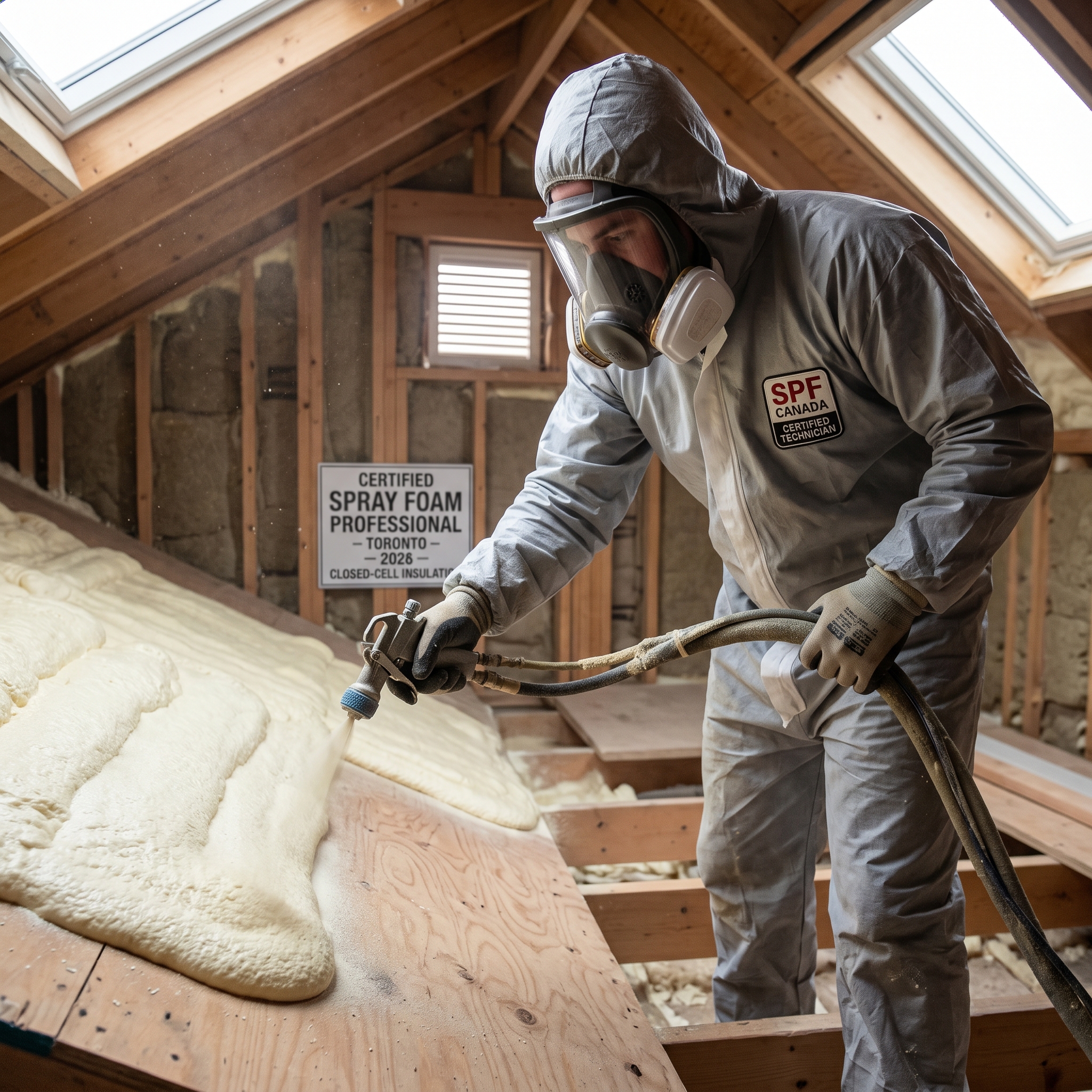
Closed Cell Spray Foam Canada Toronto 2026: Complete Guide
Closed cell spray foam insulation in Canada costs between $2.50 and $5.00 per square foot CAD installed, making it one of the most cost-effective and
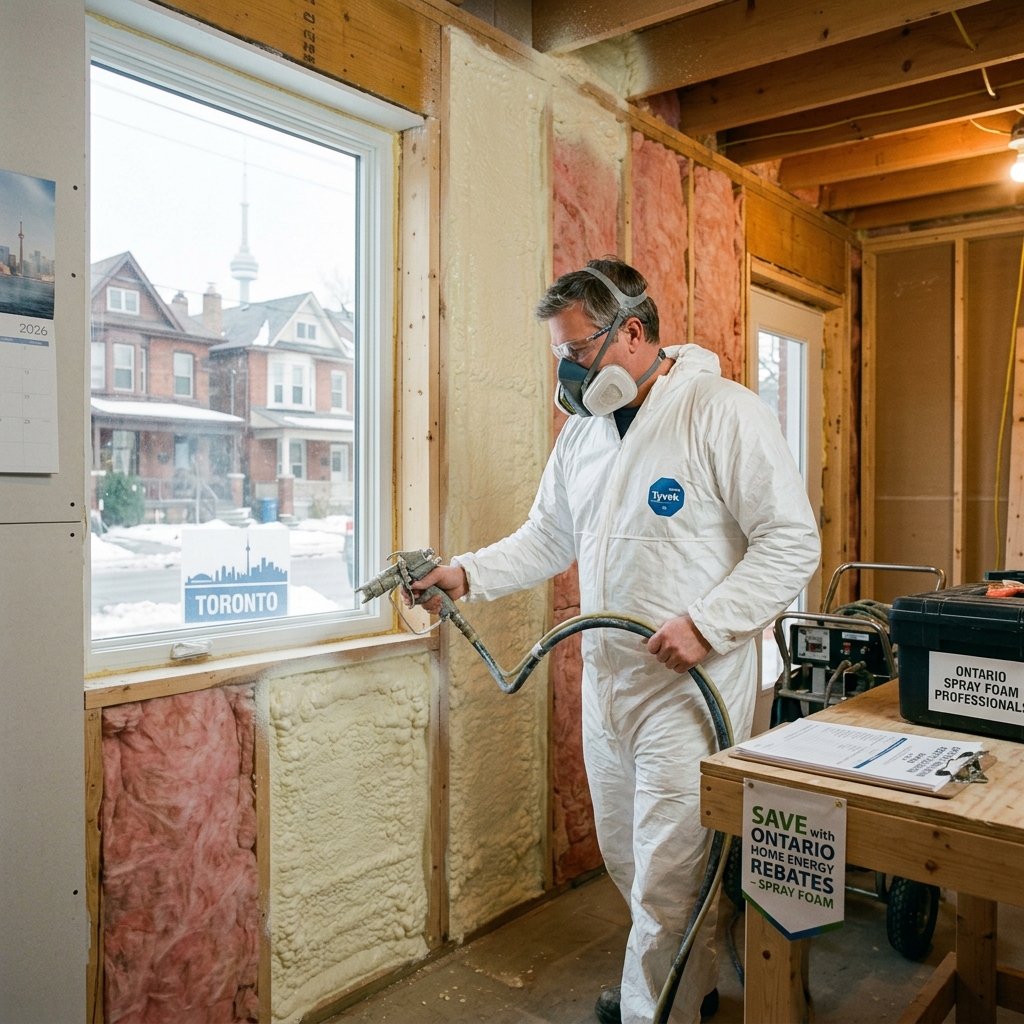
Insulation Rebate Ontario Toronto 2026: Complete Guide
Ontario homeowners who install spray foam insulation can qualify for rebates ranging from $1,600 to $10,600 CAD through federal and provincial programs — and
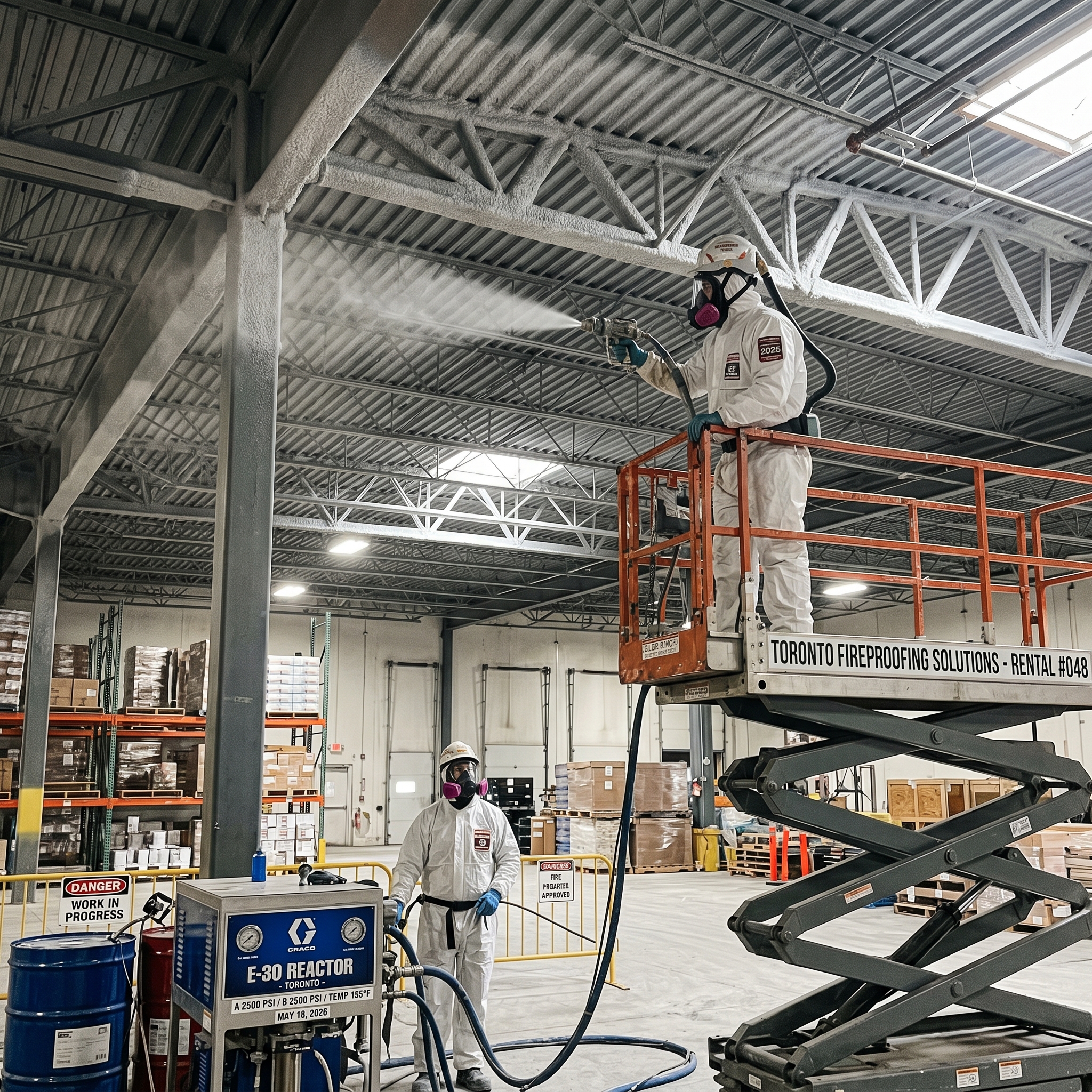
Commercial Spray Foam Fireproofing Services — Toronto & GTA 2026
Commercial spray foam fireproofing in Toronto costs $3.50–$8.00 per square foot installed in 2026, depending on required fire-resistance rating,
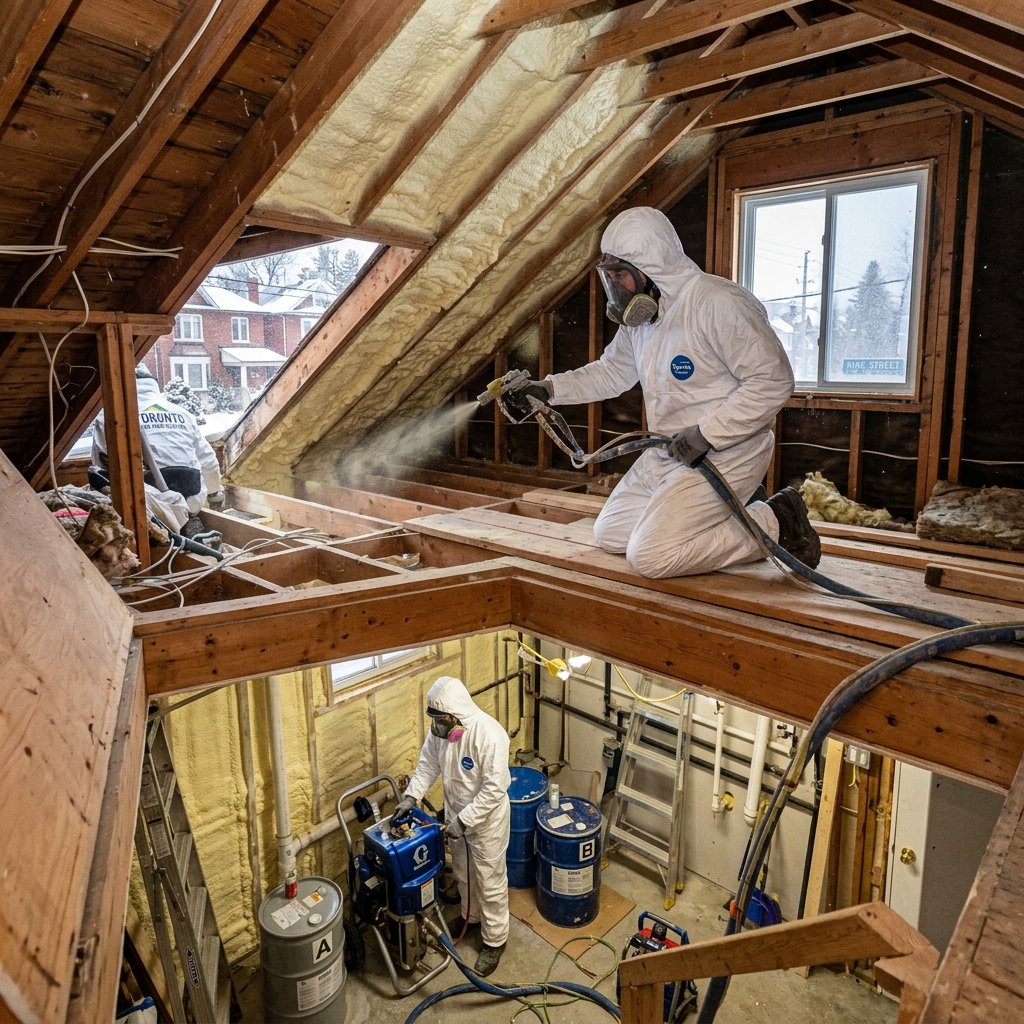
Spray Foam Insulation Rebate Ontario 2026: How to Get Up to $10,000 Back on Your Upgrade
Spray foam insulation rebates in Ontario for 2026 can put up to $10,000 CAD back in your pocket when you upgrade from fiberglass or cellulose to
Spray Foam Insulation Cost 2026 – What Toronto Homeowners Should Budget & How to Save
If you’ve been Googling “spray foam insulation cost 2026” at 2 a.m. while your furnace kicks in for the third time tonight, you’re in the right place.